
Planning meals is one of those jobs that takes ten minutes on paper and an hour in real life. You stare at the fridge, scroll recipes, forget what you already bought, and end up ordering takeout on Wednesday anyway. ChatGPT can’t cook for you, but it’s very good at the boring middle part: turning “we have chicken, rice and half a bag of spinach” into a week of dinners and a shopping list.
Below are 50 ChatGPT prompts for meal planning, grouped by the job you need done: weekly plans, budget shopping, using what’s in the fridge, meal prep, family meals, dietary needs and making the habit stick. Each one is ready to copy. Swap the details in [brackets] for your own.
Who this is for: busy parents, students, anyone cooking on a budget, and people who want to sell meal planners as a side hustle. If you’re still choosing an AI tool, start with our ChatGPT vs Claude vs Gemini comparison.
Why planning your meals is worth ten minutes a week
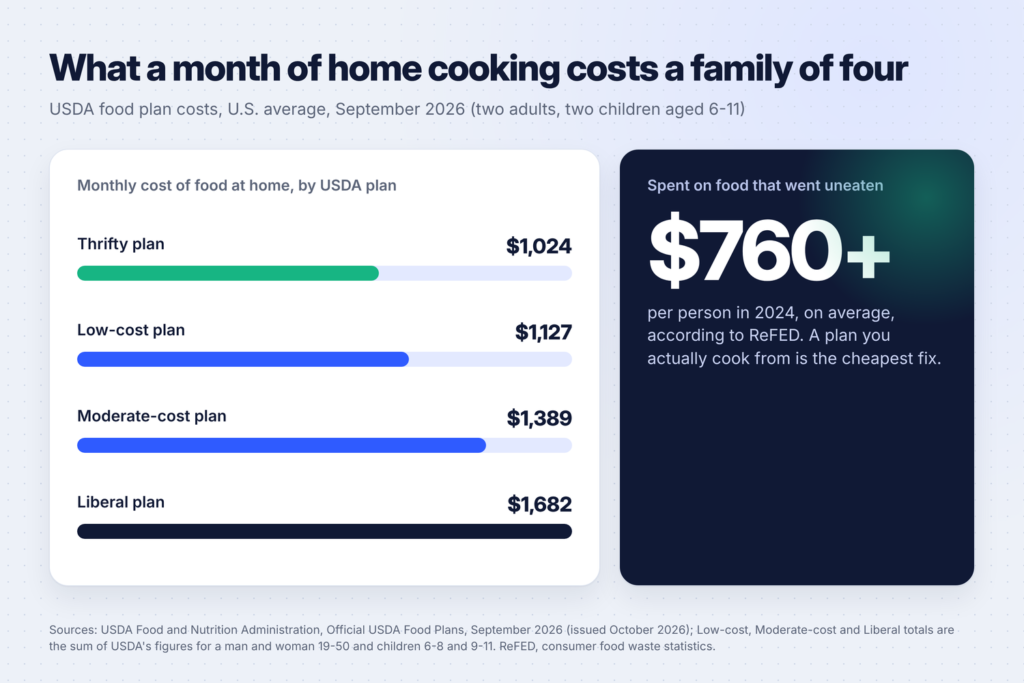
Food at home is one of the biggest costs a household can actually control. The USDA publishes what a nutritious diet cooked at home costs at four budget levels. In its September 2026 report, the Thrifty plan for a family of four (two adults and two children aged 6 to 11) comes to $1,024 a month. Adding up USDA’s figures for the same family on the other plans gives about $1,127 (Low-cost), $1,389 (Moderate-cost) and $1,682 (Liberal).
Then there’s the food that never gets eaten. According to ReFED, a nonprofit that tracks food waste in the US, the average American spent over $760 in 2024 on food that went uneaten, and uneaten groceries at home make up about a third of all consumer food waste.
A meal plan helps with both: you buy what you’ll cook, and you cook what you bought. ChatGPT makes the planning part fast enough that you’ll actually do it.
Set ChatGPT up once, then reuse it every week
The biggest time-saver isn’t any single prompt. It’s telling ChatGPT about your household once so you don’t repeat yourself every Sunday.
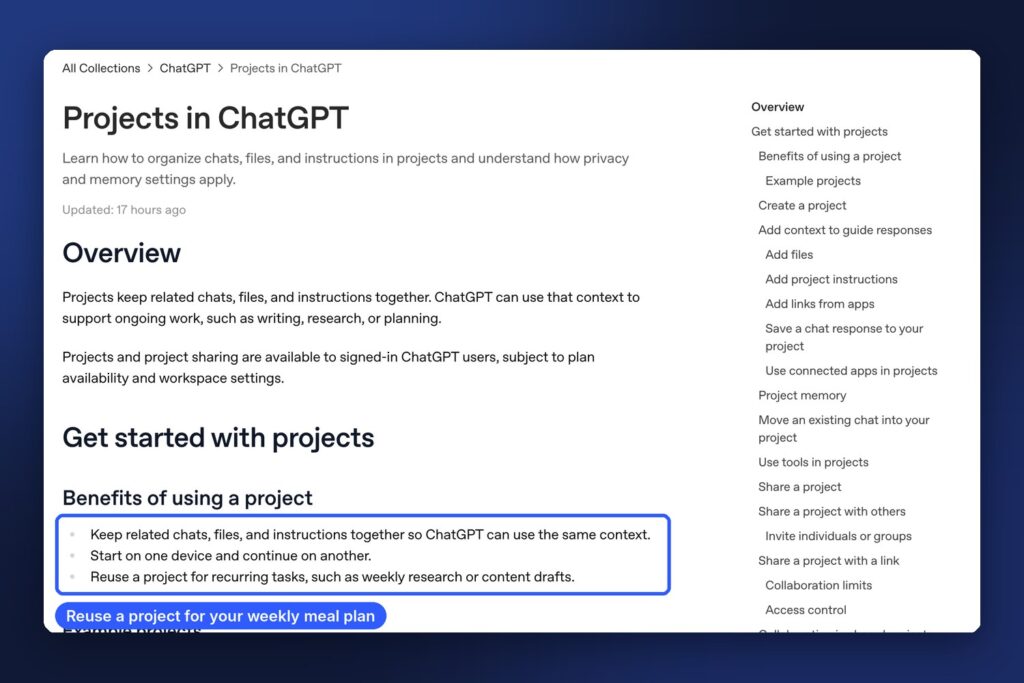
ChatGPT has a feature called Projects. OpenAI’s help article describes it as a way to keep related chats, files and instructions together, and suggests reusing a project for recurring tasks. Projects are available to signed-in users, subject to plan, and the article lists project sharing on Free, Go, Plus and Pro, so you can invite a partner to the same meal-planning project.
Here’s how to set it up:
- In ChatGPT, create a new project and call it “Meal planning”.
- Open the project settings and add instructions. OpenAI notes that project instructions apply only inside that project.
- Paste in a household profile like the one below, then edit it.
Household: 2 adults, 2 kids (ages 7 and 10).
Budget: about $120 a week for groceries.
Cooking time: 30 minutes on weekdays, longer on Sundays.
Equipment: oven, stovetop, slow cooker, air fryer.
Allergies: one child is allergic to peanuts. Never include peanuts or peanut oil.
Dislikes: mushrooms, very spicy food.
Store: [your usual supermarket]. We shop once a week on Saturday.
Style: simple family food, lots of vegetables, leftovers for lunch.
Always give me: the plan as a table, then a shopping list grouped by store section.
Now every chat inside the project starts with that context. When something changes (a new budget, a new diet), you edit the instructions once.
Free plan tip: OpenAI’s plans page lists limited memory and context on the free plan, so if ChatGPT seems to forget your profile, paste it at the top of the chat instead.
The prompt formula that works for meals
Good meal planning prompts have the same five parts. If a prompt gives you a vague answer, it’s usually missing one of these:
| Part | What to include | Example |
|---|---|---|
| Who | People, ages, appetites | 2 adults, 2 kids, one teenager who eats a lot |
| Limits | Budget, time, equipment | $100, 30 minutes, no oven |
| Food rules | Allergies, diets, dislikes | no nuts, vegetarian Mondays |
| What you have | Fridge, freezer, pantry | rice, frozen peas, 6 eggs |
| Output | The format you want back | table, shopping list by aisle, prep steps |
Ask for a format every time. “Give me ideas” gets you a paragraph. “Give me a table with day, meal, main ingredients and cook time” gets you something you can stick on the fridge.
Prompts 1-8: Weekly meal plans
These are your starting point. Run one on the weekend, then use the other sections to adjust.
- “Create a 7-day dinner plan for [household]. Budget is [$X] for the week, and weekday meals must take 30 minutes or less. Give me a table with day, meal, main ingredients and cook time.”
- “Plan breakfast, lunch and dinner for 5 workdays. Lunches should be packable and use leftovers from the night before where possible.”
- “Make a 7-day dinner plan where ingredients overlap, so nothing I buy gets used only once. After the plan, list which ingredients appear in more than one meal.”
- “Give me a 2-week rotating dinner plan I can repeat all month, with one new recipe each week so it doesn’t get boring.”
- “Plan this week’s dinners around what’s on sale: [paste items from your store’s weekly flyer].”
- “I have a busy week: late meetings Tuesday and Thursday. Plan dinners where those two nights are 15-minute meals or slow cooker meals I start in the morning.”
- “Create a theme-night dinner plan (like Taco Tuesday and Pasta Wednesday) for 7 nights, with an easy and a slightly fancier option for each night.”
- “Here’s my plan for the week: [paste it]. Check it for balance. Too much pasta? Not enough vegetables? Suggest two swaps and update the shopping list.”
Prompts 9-16: Grocery lists and budget shopping
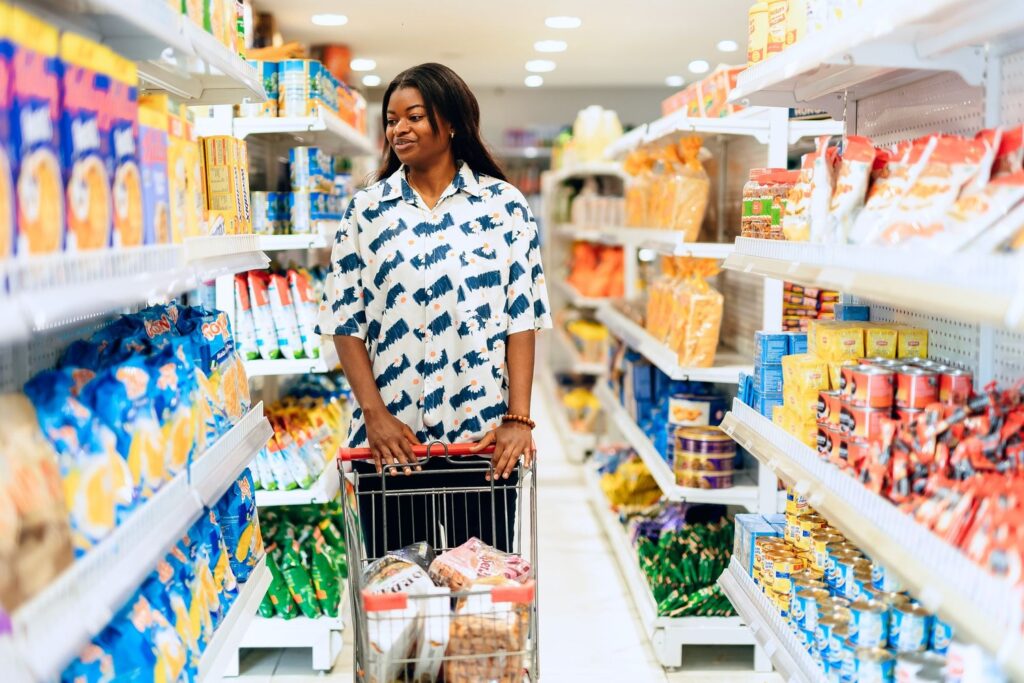
Once you have a plan, these turn it into a shopping trip that sticks to your budget.
- “Turn this meal plan into a shopping list grouped by store section (produce, meat, dairy, pantry, frozen). Combine duplicates and give quantities for [number] people.”
- “Here’s what I already have: [list]. Remove those items from the shopping list and tell me what’s left to buy.”
- “Estimate a rough cost for this shopping list at a typical US supermarket and flag the 3 most expensive items, with cheaper swaps for each.”
- “Plan 7 dinners for 4 people for under [$X]. Use cheap staples like beans, lentils, eggs, rice, oats, frozen vegetables and chicken thighs, and keep the meals varied.”
- “Which items on this list can I buy frozen or canned instead of fresh without hurting the meals? Show the swaps in a table.”
- “I buy chicken in bulk packs. Plan 4 different dinners from one [3 lb] pack of chicken thighs so none of them taste the same.”
- “Rewrite this shopping list in the order I walk through my store: produce first, then bakery, meat, dairy, frozen and pantry at the end.”
- “My grocery bill keeps going over budget. Here’s last week’s receipt: [paste items and prices]. What should I cut or swap first?”
A note on prices: ChatGPT doesn’t know what your local store charges today, so treat any cost estimate as a rough guide. For real numbers, paste in prices from your store’s website or flyer and ask it to do the maths.
Prompts 17-24: Use what’s already in your fridge
These are the prompts that save the most money, because they start with food you’ve already paid for.
- “Here’s everything in my fridge and pantry: [list]. Suggest 5 dinners I can make without going shopping, starting with the food that will go off first.”
- “I have [half a bag of spinach, 2 peppers and some cooked rice] that need using today. Give me 3 quick ideas and the full recipe for the one that takes the least time.”
- “Turn last night’s [roast chicken] leftovers into 2 completely different meals for the next two days.”
- “Make a ‘clean out the fridge’ plan for Thursday and Friday so I start the weekend shop with an empty fridge.”
- “I have a freezer full of random things: [list]. Plan 5 meals that use them, and tell me what to take out to thaw the night before.”
- “What can I make with these 5 ingredients plus basic pantry items (oil, salt, pepper, flour, spices)? [list]”
- “Plan a week of dinners where Sunday’s big meal turns into Monday and Tuesday lunches.”
- “Create a simple fridge list I can stick on the door showing what needs eating first, based on this list of what I bought and when: [list].”
When you plan around leftovers, keep food safety in mind. The US government’s cold food storage chart lists most cooked leftovers (cooked meat and poultry, soups and stews, pizza) at 3 to 4 days in the fridge. Freeze anything you won’t eat in time. If ChatGPT plans a leftover for day 5 or 6, ask it to move that meal earlier or freeze the portion.
Prompts 25-32: Meal prep and batch cooking
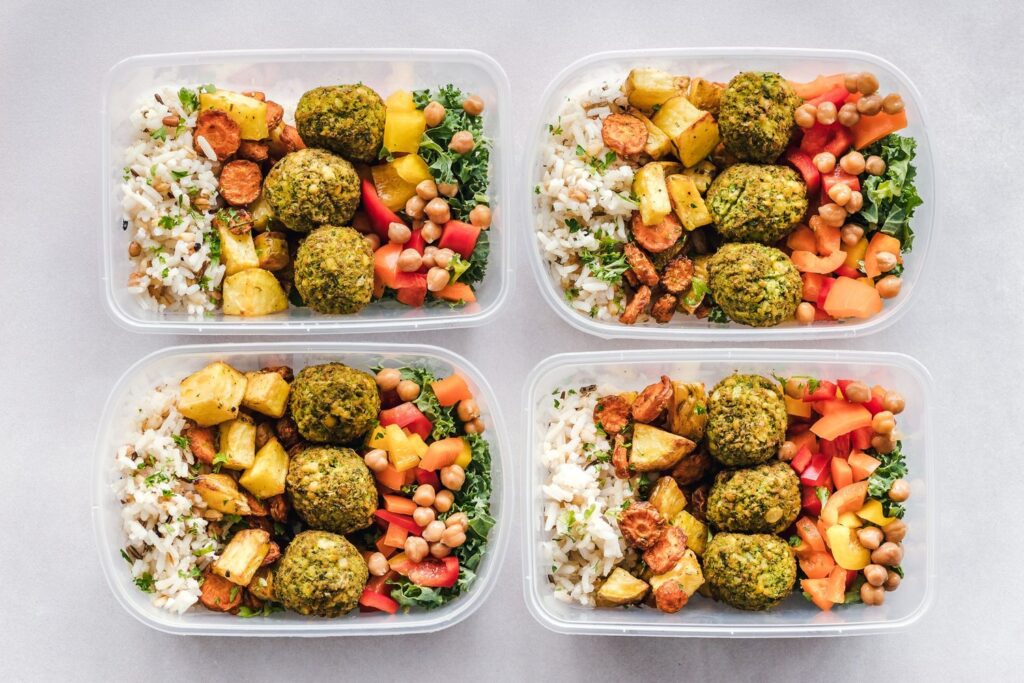
If you’d rather cook once and eat all week, these prompts plan the prep session for you.
- “Plan a 2-hour Sunday meal prep that covers 5 weekday lunches and 3 dinners. List the steps in the order I should do them so the oven and stovetop are always in use.”
- “Give me 3 base ingredients to batch cook on Sunday (like a grain, a protein and a sauce) and show 5 different meals I can make from them during the week.”
- “Which of these meals freeze well and which don’t? [paste plan] Mark them in a table and tell me how to portion the freezer ones.”
- “I have a slow cooker. Plan 4 ‘dump and go’ dinners where I can prep the ingredients into freezer bags on Sunday.”
- “Write a prep checklist for this week’s plan: what to chop, cook, marinate or portion ahead, and how to store each item.”
- “Plan 5 high-protein lunches I can prep in 1 hour, using no more than 10 ingredients in total.”
- “Scale this recipe from 4 servings to 10 for meal prep and adjust the cooking time if needed: [paste recipe].”
- “Create a ‘freezer stash’ plan: 6 meals I can cook double of this month, so I always have a backup dinner in the freezer.”
Prompts 33-40: Family meals and picky eaters

Cooking for kids, teens and adults at the same table needs a different kind of plan. These help.
- “Plan 7 family dinners where the kids’ version and the adults’ version come from the same pot (for example, plain pasta for the kids, spicier sauce for the adults).”
- “My 6-year-old only eats [chicken nuggets, pasta and apples]. Suggest 5 dinners that include one ‘safe’ food on the plate plus something new to try.”
- “Give me 10 lunchbox ideas for school that don’t need heating and don’t include nuts.”
- “Plan a week of after-school snacks that are cheap, easy and don’t spoil the appetite for dinner.”
- “Suggest 5 dinners my [8 and 11-year-old] can help cook, and give each child a job that matches their age.”
- “I’m cooking for a family of 5 with a teenager who eats twice as much as everyone else. Adjust this plan’s portions and shopping list: [paste plan].”
- “Plan a weekend of easy hosting: Saturday dinner for 8 people and a Sunday brunch, with as much as possible made ahead.”
- “Create a list of 20 family dinners we can rotate. Mark each one with cost (low, medium, high) and time (under 20 minutes, 30 minutes, longer).”
Prompts 41-45: Dietary needs and healthier eating
These help with diets and preferences. One honest warning first: ChatGPT is not a doctor or a dietitian. OpenAI’s own Health in ChatGPT help article says it’s meant to support, not replace, medical care, and isn’t a diagnostic or treatment tool. If you’re planning for diabetes, kidney disease, pregnancy, a serious allergy or weight loss under medical care, use ChatGPT to organise the plan your doctor or dietitian gave you, not to invent one.
- “Plan 7 vegetarian dinners that still feel filling, with a protein source in every meal. Show the protein source in its own column.”
- “Here’s the eating plan my dietitian gave me: [paste it]. Turn it into a 7-day meal plan and a shopping list. Don’t change any of the rules.”
- “Plan a week of dinners with more vegetables in every meal, without making the kids notice too much. Show where the vegetables are hidden.”
- “I’m cooking for one person with a gluten-free diet and one who eats everything. Plan 5 dinners where one meal works for both of us.”
- “Check this recipe for these allergens: [list allergens]. List every ingredient that might contain them, including hidden sources like sauces and stock.” (Always double-check labels yourself. Recipes and products change.)
Prompts 46-50: Make the habit stick (and turn it into a side hustle)
The last five help you keep planning every week, and show you how to turn the skill into something you can sell.
- “Ask me 8 quick questions about my week (schedule, budget, cravings, what’s in the fridge), one at a time, then build my meal plan from my answers.”
- “Review the last 4 weeks of meal plans in this project. Which meals did we repeat most? Suggest 3 new ones that are similar but different.”
- “Turn this week’s plan into a printable one-page layout: a table for the plan on top and the shopping list in two columns below.”
- “Create 10 reusable ’emergency dinners’ I can make from pantry and freezer staples when the plan falls apart.”
- “I want to sell a meal planner on Etsy. Suggest 10 niches (for example, budget families, students, shift workers) and what each planner should include.”
Meal planners are a popular printable. If prompt 50 got you thinking, read our list of 50 printable ideas that sell on Etsy and our guide to starting an Etsy digital download shop with AI.
A sample week, start to finish
Here’s what a real Sunday session looks like using the prompts above. Total time: about 15 minutes.
- Check the fridge (2 minutes). Open your Meal planning project and use prompt 17 with a quick list of what’s left.
- Build the plan (3 minutes). Use prompt 1, adding: “Use up the items from my fridge first.”
- Fix the plan (3 minutes). Use prompt 8 to check the balance, and prompt 6 if you have a busy night.
- Get the list (2 minutes). Use prompt 9, then prompt 10 to remove what you already have.
- Plan the prep (5 minutes). Use prompt 29 for a prep checklist, then save the plan and list to your phone.
By the end you have a plan for the week, a shopping list sorted by aisle and a prep list. Next Sunday, prompt 47 helps you improve on it.
Common mistakes to avoid
- Giving no limits. Without a budget, time and headcount, ChatGPT plans meals for a food magazine, not your Tuesday night.
- Trusting the prices. Cost estimates are rough. Paste real prices from your store if your budget is tight.
- Skipping the allergy check. Put allergies in your project instructions and still read every recipe and label yourself.
- Planning too many new recipes. One or two new meals a week is plenty. Fill the rest with meals you already know.
- Forgetting leftovers’ clock. Most cooked leftovers last 3 to 4 days in the fridge, so plan them early in the week or freeze them.
FAQ
Is ChatGPT good for meal planning?
Yes, for the planning and list-making part. It’s quick at building weekly plans, shopping lists and prep schedules from your limits. It can’t check your local prices or your fridge, so the more detail you give it, the better the plan.
Can I use ChatGPT for meal planning for free?
Yes. All of the prompts in this post work on the free plan. OpenAI lists more memory and higher usage limits on paid plans, which helps if you plan every week in one long project, but you don’t need a paid plan to start.
How do I make ChatGPT remember my family’s preferences?
Create a project and add your household profile to its instructions, as shown above. If you’re on the free plan and it forgets, paste the profile at the top of each new chat.
Can ChatGPT make a meal plan for weight loss or a medical diet?
Use it carefully. OpenAI says health features in ChatGPT are meant to support medical care, not replace it. Get the plan from your doctor or a registered dietitian, then use prompt 42 to turn it into meals and a shopping list.
Can ChatGPT tell me how much my groceries will cost?
Only roughly. It doesn’t have your store’s current prices. For accurate totals, paste in prices from your store’s website or receipt and ask it to add them up.
Keep going
If ChatGPT is saving you time in the kitchen, put it to work elsewhere too. See 15 side hustles you can do with ChatGPT and 25 AI side hustles for stay-at-home moms. If you’d like to sell meal planners, start with our list of 50 printable ideas that sell on Etsy.